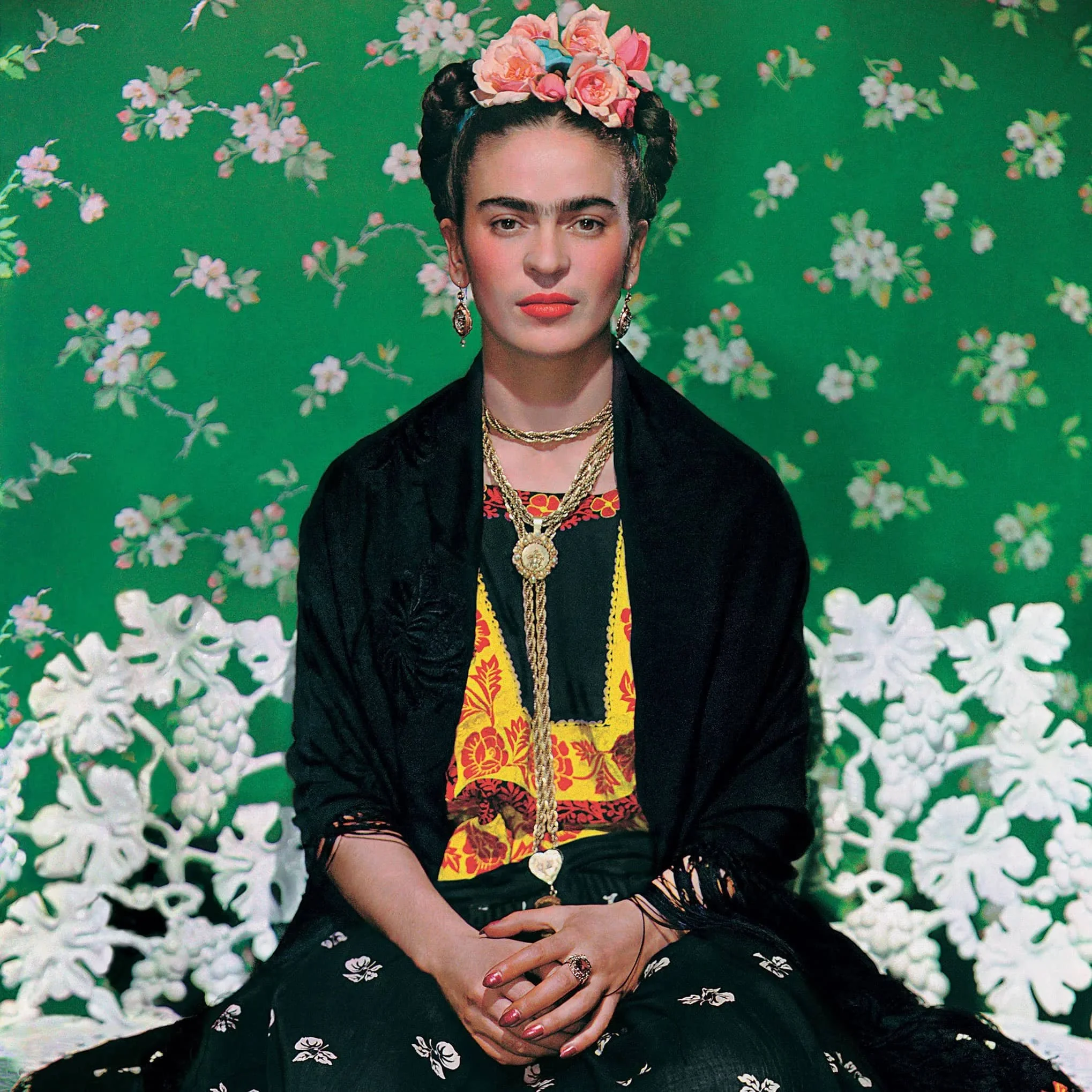
Frida Kahlo - Painter of the Female Experience
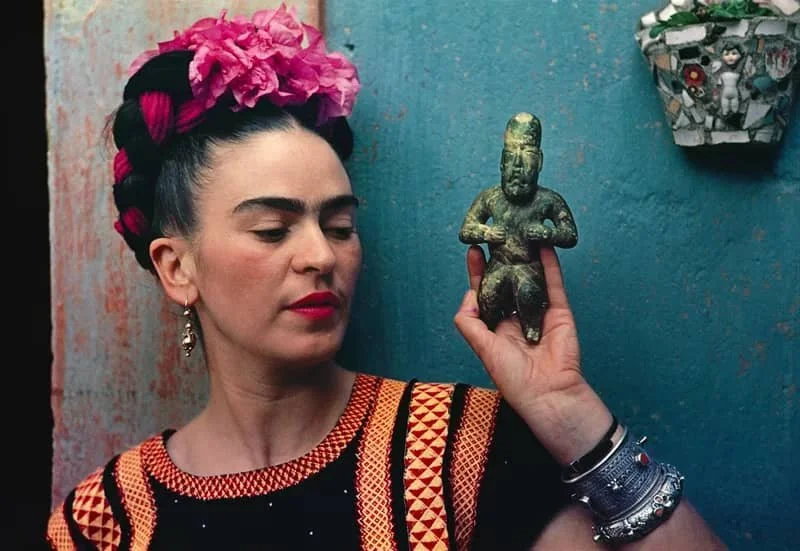
Frida Kahlo is famous for her deeply personal self-portraits exploring themes of identity, pain, and the female experience. Her life of physical suffering and passionate living, combined with her uncompromising portrayal of her own reality through art has contributed to her elevation to feminist and cultural icon.
Born to a German father and a Mexican mother, Kahlo spent most of her childhood and adult life at La Casa Azul, her family home in Coyoacán – which is now the Frida Kahlo Museum. Known for her many portraits, including self-portraits, and works inspired by Mexico, she took real joy in her Mexican heritage and employed a traditional naïve folk art style to explore questions of identity, post colonialism, gender, class, and race.
When Kahlo was six, she contracted polio. While the experience made her disabled and reclusive, it brought her closer to her father. He taught her about literature, nature, philosophy, and encouraged her to play sports, despite the fact that most physical exercise was seen as unsuitable for girls. He also taught her photography.
Her paintings often had strong autobiographical elements and mixed realism with fantasy. In addition to belonging to the post-revolutionary Mexicayotl movement, which sought to define a Mexican identity, Kahlo has been described as a surrealist or magical realist, although she did not identify as such. She is also known for painting about her experience of chronic pain, with which she lived her whole life after a terrible bus accident aged just 18.
During recovery, she returned to her childhood interest in art, and considered a career as a medical illustrator, which would combine her interests in science and art.
Her mother provided her with a specially-made easel, which enabled her to paint in bed, and her father lent her some of his oil paints. She had a mirror placed above the easel, so that she could see herself. Painting became a way for Kahlo to explore questions of identity and existence. She explained, “I paint myself because I am often alone and I am the subject I know best.” She later stated that the accident and the isolating recovery period made her desire “to begin again, painting things just as she saw them with her own eyes and nothing more.”
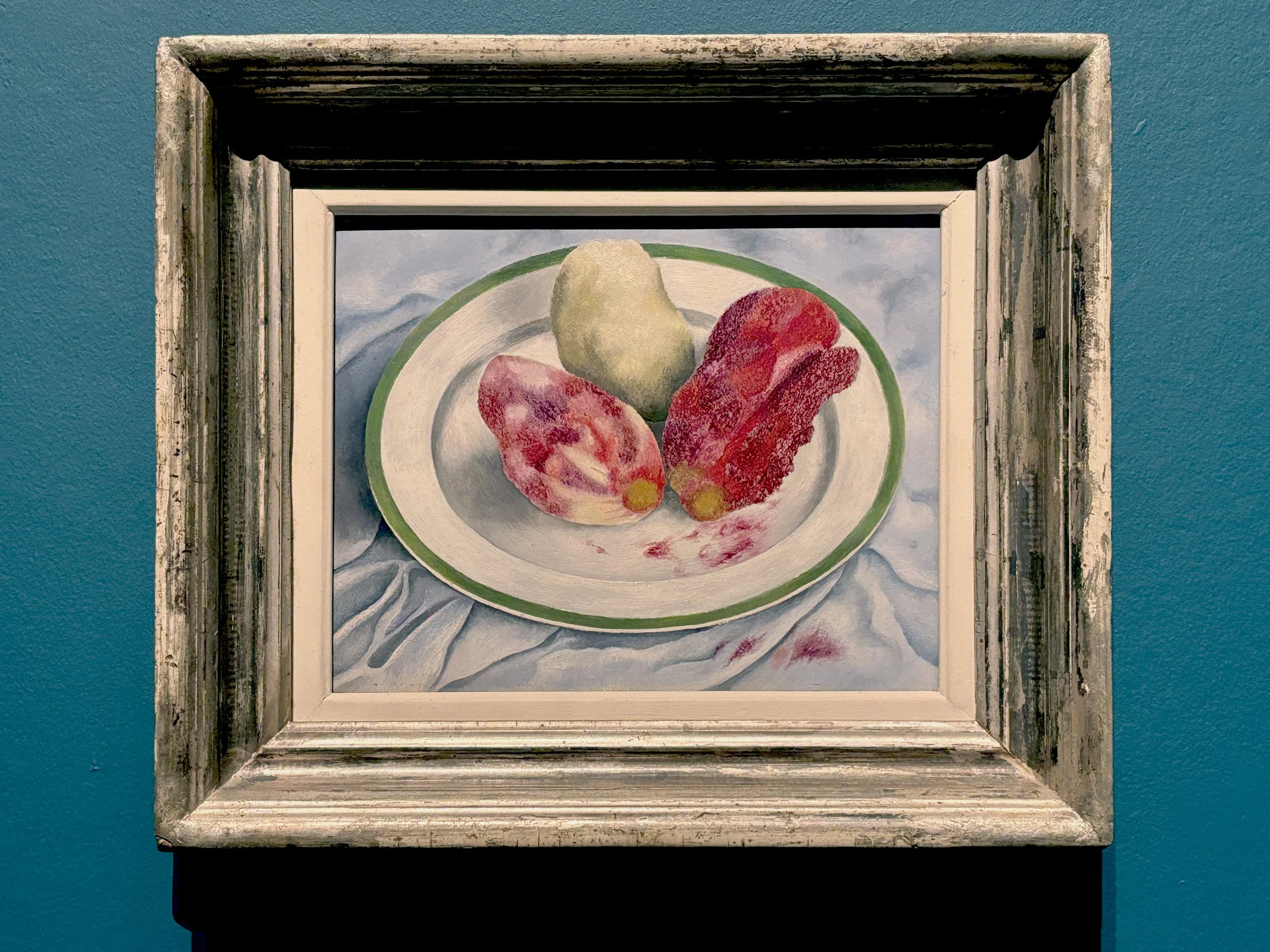
‘Cactus Fruits’ by Frida Kahlo
Around this time, she approached artist Diego Rivera, whom she had encountered years ago when he was painting a mural in her school, to ask for his opinion whether she should pursue a career as a painter. Despite the large age gap, according to Rivera, the two began their “courtship in earnest” shortly after this encounter. He was 21 years her senior and had two common law wives.
Kahlo’s interests in politics and art led her to join the Mexican Communist Party in 1927, where she once again met Diego. The couple married in 1929 and spent the late 1920s and early 1930s travelling together in Mexico and the United States. During this time, she developed her style, drawing her inspiration from Mexican folk culture, creating mostly small self-portraits that mixed elements from pre-Columbian and Catholic beliefs.
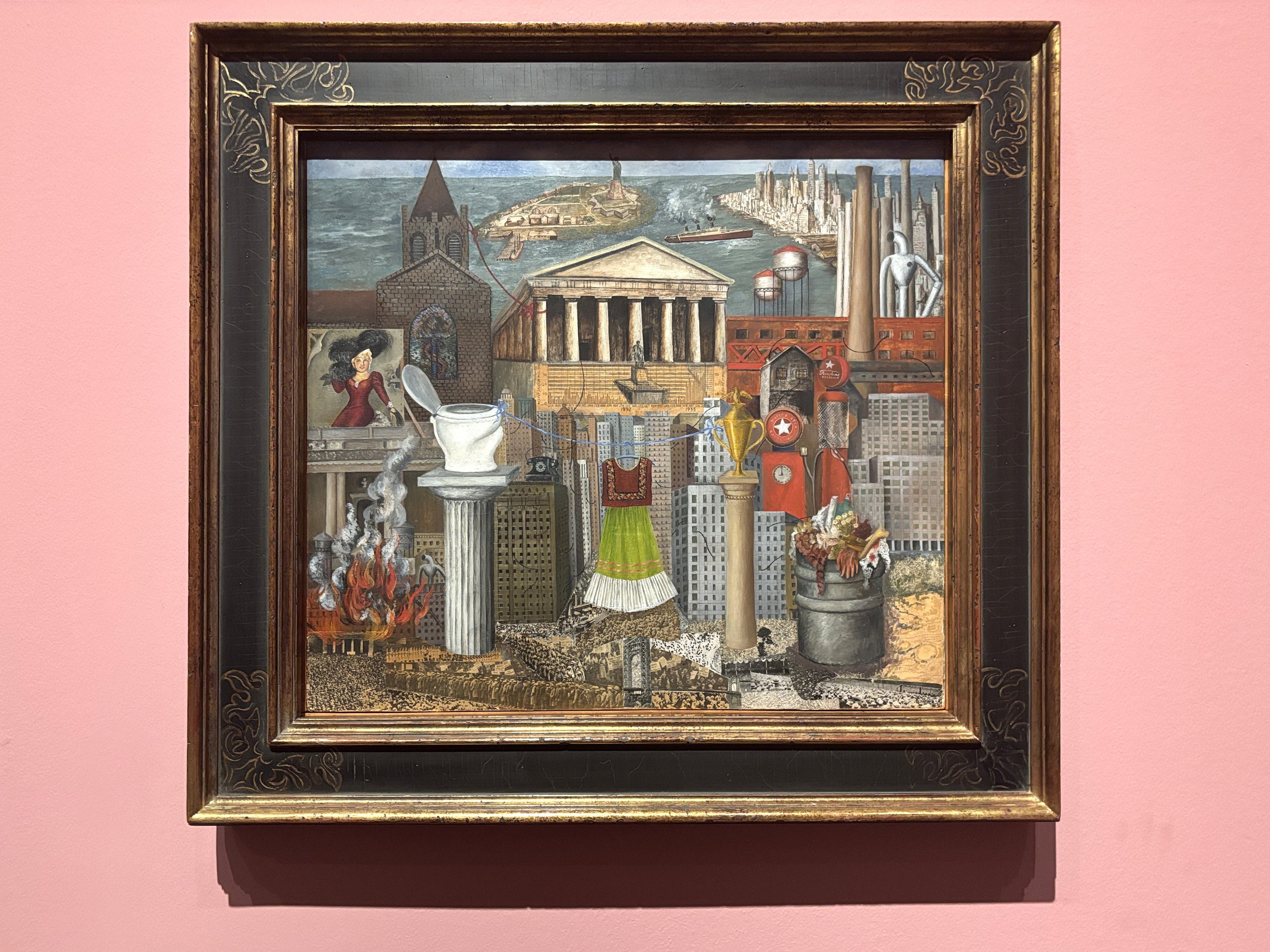
‘My Dress Hangs There’ by Frida Kahlo
Her paintings raised the interest of surrealist artist André Breton, who arranged for Kahlo’s first solo exhibition at the Julien Levy Gallery in New York in 1938; the exhibition was a success and was followed by another in Paris in 1939. The Louvre purchased a painting from Kahlo, The Frame, making her the first Mexican artist to be featured in their collection. Breton was so impressed with Frida he described her work as “a ribbon around a bomb”.
Throughout the 1940s, Kahlo participated in exhibitions in Mexico and the United States and worked as an art teacher. Kahlo’s always-fragile health began to decline in the same decade. She had her first solo exhibition in Mexico in 1953, shortly before her death in 1954 at the age of 47.
Kahlo’s work as an artist remained relatively unknown until the late 1970s, when her work was rediscovered by art historians and political activists. By the early 1990s, not only had she become a recognized figure in art history, but she was also regarded as an icon for Chicanos, the feminism movement, and the LGBTQ+ community. Kahlo’s work has been celebrated internationally as emblematic of Mexican national and Indigenous traditions and by feminists for what is seen as its uncompromising depiction of the female experience and form.
Her 1940 self-portrait titled The Dream (The Bed) holds the record for the most expensive work by a female artist ever auctioned, at $54.7 million.