
Bridget Riley - Optical Illusion Artist
Born on 24 April 1931 in Norwood, London Bridget Louise Riley is an English painter known for her optical art paintings. The daughter of a businessman, her childhood was spent in Cornwall and Lincolnshire. She studied at Goldsmiths’ College from 1949 to 1952, and at the Royal College of Art from 1952 to 1955. She began painting figures in a semi-impressionist manner, then changed to pointillism around 1958, mainly producing landscapes. In 1960 she evolved a style in which she explored optical illusions which produce a disorienting effect on the eye. She now lives and works in London, Cornwall and the Vaucluse in France.
Riley taught children for two years before joining the Loughborough School of Art, where she initiated a basic design course. She then taught at Hornsey School of Art, and Croydon School of Art. She worked for the J. Walter Thompson Group advertising agency from 1960, but gave up teaching and advertising work in 1963-4.
In 1959, Riley met the painter and art educator Maurice de Sausmarez at a residential summer school that he ran. He became her friend and mentor, and partner for a time. He urged her toward Futurism and Divisionism and artists such as Klee and Seurat. They spent the summer of 1960 painting in Italy where they visited the Venice Biennial which was hosting a large exhibition of Futurist art. Riley painted ‘Pink Landscape’ in a pointillist study of the landscape near Radicofani at that time.
When the relationship ended, Riley shifted her focus, creating striking geometric Optical Art. She began to develop her signature style with patterns that explore the dynamism of sight, by creating the illusion of movement.
At first she worked with the contrast of black and white, occasionally introducing tonal scales of grey. In 1960 she saw sculptures by the Italian artist Umberto Boccioni in Venice. She wanted to make paintings that had curves like Boccioni’s sculptures.
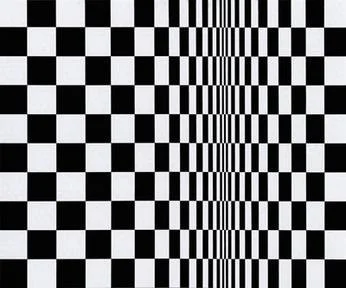
Movement in Squares by Bridget Riley - 1961
She also started experimenting with colour, putting warm and cold colours together to make the paintings more vibrant. She travelled to many different countries, like Egypt and India, and looked closely at the way the artists there used colour. She was interested in the way hot countries used very bright colours to stop them fading in the sun. In 1993 she painted Nataraja, a vibrant and colourful piece inspired by a trip she made to India. Nataraja means Lord of the Dance, and refers to the Hindu god Shiva.
In some works, lines of colour are used to create a shimmering effect, while in others the canvas is filled with tessellating patterns. Typical of these later colourful works is ‘Shadow Play’.

Shadow Play by Bridget Riley 1990
In 1961, she acquired a derelict farm with her partner Peter Sedgley. Back in London, in the spring of 1962, Victor Musgrave of Gallery One held her first solo exhibition. In 1968, Riley, with Sedgley and the journalist Peter Townsend, created the artists’ organisation SPACE (Space Provision Artistic Cultural and Educational), with the goal of providing artists large and affordable studio space. Her paintings since 1961, have been executed by assistants. She meticulously plans her composition’s design with preparatory drawings and collage techniques; her assistants paint the final canvases with great precision under her instruction.
Group shows include Young Contemporaries, London, 1955; Diversion, South London Art Gallery 1958; an Arts Council Touring Exhibition, 1962; Tooth’s Critics Choice Exhibition, selected by Edward Lucie-Smith, 1963; John Moores’ Exhibition, Liverpool, 1963; The New Generation, Whitechapel Gallery 1964; Movement, Hanover Gallery, London, 1964; Painting and Sculpture of a Decade 1954-1964, Tate Gallery, 1964; and Op Art, touring Ireland in 1967. Her numerous European and American exhibitions include The Sixties Collection Revisited, Aldrich Museum of Contemporary Art, Ridgefield, Connecticut, 1978.
Riley was awarded the AICA Critics Prize a John Moores’, Liverpool Open Section prize in 1963. In 1964 she was awarded a Peter Stuyvesant Foundation Travel bursary to the USA. In 1968 she won an International Painting Prize at the Venice Biennial.
Her first solo exhibition was held at Gallery One in 1962 with a second solo show the following year. Other solo shows were held at Nottingham University, 1963; Richard Feigen Gallery, New York and Feigen Palmer Gallery, LA, 1965; Museum of Modern Art, New York, with US tour, 1966; Venice Biennial, British Pavilion, 1968; Hayward Gallery, London, 1971; National Gallery, Prague, 1971; Hayward Gallery and Kunsthalle Nuremberg, 1992; Kettle’s Yard, Cambridge, 1995; and Waddington Galleries, London, 1996.